Aug 26, 2026 | I'm a Parent, I'm a Teacher, ILT Blog
Over the last few years there seems to have been an enormous leap in explanations for Learning Disabilities (LD). There is talk of genetic predisposition, processing times (e.g. slow auditory processing), brain imaging techniques and findings, quantified EEGs, brain biofeedback, sound therapy, light therapy, and many others. Each new avenue quickly gains a following of professionals offering help.
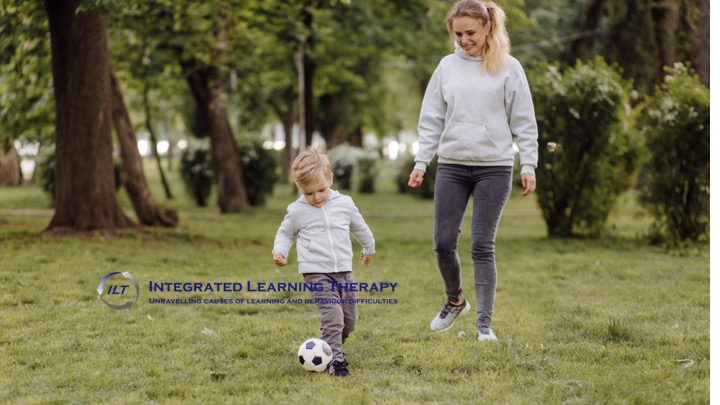
In the midst of all this, one might wonder if the ‘old-fashioned’ belief in movement programmes is outdated. With all the computerized programmes, new therapies and drugs that speed up processing times being more and more widespread, can we motivate the belief in the power of movement programmes? Why does Integrated Learning Therapy (ILT) still achieve such good results, even though the approach does not rely on technology or sophisticated equipment?
The answer lies in the simple truth that LD is not just a cognitive (intellectual) deficit. A really close look at children identified has having LD will show that they also have significantly high deficits in several motor (movement) areas. This was supported by research in England, which suggested that very refined, accurate tests of balance might be a quick way of screening for LD[1].
Integrated Learning Therapy (ILT) finds that movement training is wonderfully beneficial. It refines and speeds up kinesthetic (feeling of movement) processing as well as auditory processing, visual processing and the integration of all three to produce balanced, calmer individuals who become more proficient in reading, spelling, maths and writing.
ILT sees that the learning problem is in the brain of children who have difficulties – not because of lack of intelligence. The brain ‘wiring’ is faulty or incomplete, leading to neurological disorganization. Look at the behaviour of a child with LD. They reflect the disorganized neural networks in their brains with their disorganized ways of trying to learn and cope with the demands of home and school. They are struggling with information that is not getting through from skin, body, ears and eyes to the brain, or they are processing the information too slowly, or it may be scrambled along the way. Some children may be hearing only part of a word or sentence and, to make matters worse, what they do hear may be processed slowly and is confusing. They don’t hear full instructions from teachers and parents. Others can’t use their eyes to learn because vision might not be supporting them – even though optometrists declare their sight to be normal.
To add insult to injury, their two brain hemispheres may not be working together. You can see signs of this in school-aged children: they don’t automatically know their left from their right, they can’t do more than one thing at a time, handwriting and producing written work is tedious and really hard because they struggle to organize themselves or their work. Not surprisingly, they become frustrated with the daily effort and may have meltdowns. Simply put, LD children are usually working much, much harder than their more ‘learning ready’ classmates.
The good news
The good news is that we can speed up the rate at which information reaches the brain and is correctly processed. Brain networks can be reinforced to be more stable – and we do this with the knowledge that the brain is plastic and in a constant state of change throughout our lifespans.
Image supplied by Freepik.
[1] Angela Fawcett, in Pheloung, B. Help your class to learn. Manly: Australia.
Aug 13, 2026 | I'm a Parent, I'm a Teacher, ILT Blog
Perhaps you sense that your child is not performing up to her potential. Perhaps she is struggling at school or doesn’t show the same mastery of age-expected skills as older siblings. Could she have a learning disability?
For reasons not well understood, learning disabilities are fairly common these days. This has led to increased interest into the relationship between brain functioning and a child’s ability to cope with school demands. As a result of many studies, we now know that a child who finds schoolwork hard is not ‘naughty’, lazy or stupid. We know that even exceptionally intelligent children and those who have the privilege of attending the best schools can still show problems with learning. But we also know that children with a learning disability are not doomed to lifelong failure.
As a parent, the more you know about learning disabilities the earlier you’ll be able to recognise the symptoms. This is important because timing can be crucial to addressing and perhaps resolving a problem before school going age, when children begin to find learning hard, lose interest, develop a lack of confidence and even develop unhealthy coping techniques to compensate.
But there is a difference between recognising symptoms of a learning disability and being able to identify and define its nature. This is where you need a specialist to help you correctly identify the source of the difficulty and know what to do to eliminate it. Remember that sometimes the symptoms of a difficulty may have no clear connection to the underlying cause. Josh might have problems with mathematics but hiring a tutor or remedial teacher to help him with his computational problems may not be the solution. If he has a language processing problem, for example, he may not understand the problems presented to him as ‘story sums’ (e.g. ‘If Betty has seven Rand and loses five ….). Trying to ‘fix’ a symptom without addressing its source can only lead to frustration and a loss of time (and money). To the child, such efforts can compound the problem because in spite of trying, they don’t show improvement. They become discouraged, frustrated and even angry. Some might begin to act out or withdraw, but either way, the family experiences a deluge of emotions which affects all members.
As a parent, you feel responsible for finding the best solution possible for your child. But before you seek out the help of professionals, you could try to understand more about learning disabilities so that you can speak to professionals on a more equal footing. It is also important to project confidence to your child. If you display anxiety and become stressed because of your concerns, your child will also begin to feel more anxious. Remember that there is help out there, and you’ll be doing all you can to help in the most effective way possible.
The causes of learning difficulties are many, and their symptoms are sometimes mistaken for the cause. For example, a child who struggles with inattention and restlessness may quickly be said to ‘have’ ADHD. This isn’t true. The ability to concentrate and keep the body still can be linked to allergies, nutrition, retained reflexes and other aspects of neurodevelopment, which refers to the development of the brain.
Other commonly diagnosed disabilities include dyslexia, (reading, spelling), dyscalculia (understanding numbers and maths concepts), dysgraphia (writing), dyspraxia (uncoordinated body movements), and auditory processing disorder (trouble with interpreting sounds).
If your child shows any of these difficulties, remember that the symptoms suggest that the child’s brain may not have developed in all areas needed to process information. A good starting point may be to find a professional who is knowledgeable about neurodevelopment and willing to look further than treating the symptoms the child shows.
Image supplied by Freepik.
Aug 5, 2026 | I'm a Parent, I'm a Teacher, ILT Blog
According to the World Health Organisation (WHO), nearly 80% of the world’s teenagers don’t get enough physical activity. A recent study, from the University of Montreal, suggests that the amount of physical activity a young child engages in – around the age of 2.5 years – sows the seeds for later sedentary or active habits.
The results show that three simple movement habits in toddlerhood—active play with parents, limited screen time (less than an hour per day) and sufficient sleep—significantly predict a more physically active lifestyle a full decade later. Each ‘good’ movement habit at age 2.5 was associated with roughly five more minutes of outdoor play per day at age 12 – for both boys and girls. Girls with ‘good’ movement habits at an early age also showed higher levels of leisure-time physical activity at greater intensity and frequency. This is important because at adolescence, girls are especially at risk of becoming sedentary.
The researchers concluded that active parent-child time – playing, moving, being physically engaged together – seems to be the single most powerful lever for establishing healthy long-term movement habits. The shared experiences seem to help children associate movement with enjoyment and motivation.
This research shows the importance of healthy family habits, such as encouraging active play, setting boundaries around screen time and prioritising quality sleep. It also stresses the importance of following the WHO guidelines for children under five – at least 180 minutes of physical activity per day, no more than one hour of sedentary screen time, and 11 – 14 hours of sleep.
The paper is published in the Journal of Developmental & Behavioral Pediatrics.
Image supplied by Freepik.
Jul 29, 2026 | I'm a Parent, I'm a Teacher, ILT Blog
Integrated Learning Therapy includes careful attention to aspects of a child’s auditory processing. We understand that children who have a left dominant ear, for example, may process spoken language more slowly. This means that a teacher’s instructions may not all be clearly heard and understood if delivered too quickly – especially in a classroom environment which is seldom absolutely quiet. Lesson content may be a bit scrambled because of slower transmission of sounds.
It is always good to have confirmation that our knowledge is accurate and supported by empirical evidence. This came in the form of an interesting article recently. Here is the source: The Acoustical Society of America “Want to Listen Better? Lend a Right Ear.” NeuroscienceNews. NeuroscienceNews, 6 December 2017.
The gist of the article is summarised below.
Basically, the research found that in noisy environments, the right ear leads the way for optimal auditory information processing.
Listening is a complicated task. It requires sensitive hearing and the ability to process information into cohesive meaning. Add everyday background noise and constant interruptions by other people, and the ability to comprehend what is heard becomes that much more difficult.
Audiology researchers at Auburn University in Alabama have found that in such demanding environments, both children and adults depend more on their right ear for processing and retaining what they hear.
The research team’s work is based on dichotic listening tests (testing the ability of each ear), used to diagnose, among other conditions, auditory processing disorders in which the brain has difficulty processing what is heard.
In a standard dichotic test, listeners receive different auditory inputs delivered to each ear simultaneously. The items are usually sentences (e.g., “She wore the red dress”), words or digits. Listeners either pay attention to the items delivered in one ear while dismissing the words in the other (i.e., separation), or are required to repeat all words heard (i.e., integration).
According to the researchers, children understand and remember what is being said much better when they listen with their right ear.
Sounds entering the right ear are processed by the left side of the brain, which controls speech, language development, and portions of memory. Each ear hears separate pieces of information, which is then combined during processing throughout the auditory system.
However, young children’s auditory systems cannot sort and separate the simultaneous information from both ears. As a result, they rely heavily on their right ear to capture sounds and language because the pathway is more efficient.
What is less understood is whether this right-ear dominance is maintained through adulthood. To find out, the research team asked 41 participants ages 19-28 to complete both dichotic separation and integration listening tasks.
With each subsequent test, the researchers increased the number of items by one. They found no significant differences between left and right ear performance at or below an individual’s simple memory capacity. However, when the item lists went above an individual’s memory span, participants’ performance improved an average of 8 percent (some individuals’ up to 40 percent) when they focused on their right ear.
“Conventional research shows that right-ear advantage diminishes around age 13, but our results indicate this is related to the demand of the task. Traditional tests include four-to-six pieces of information,” said Aurora Weaver, assistant professor at Auburn University and member of the research team. “As we age, we have better control of our attention for processing information as a result of maturation and our experience.”
In essence, ear differences in processing abilities are lost on tests using four items because our auditory system can handle more information.
“Cognitive skills, of course, are subject to decline with advance aging, disease, or trauma,” Weaver said. “Therefore, we need to better understand the impact of cognitive demands on listening.”
In the case of younger children who have not decided which ear is dominant, it can help to encourage the right ear to be the leading ear. If a child is strongly left-eared dominant, it can help know this so that necessary classroom adjustments can be made. Either way, Integrated Learning Therapy practitioners are there to help.
Image supplied by Freepik.
Jul 22, 2026 | I'm a Parent, I'm a Teacher, ILT Blog
Integrated Learning Therapy (ILT) is a neurodevelopmental approach that takes note of all the factors that can interfere with a child’s ability to cope with learning and living. This means that we aim for an holistic view of the child rather than focusing on a narrow range of possible causes of learning disabilities. As a result, we tend to almost ignore the symptoms of the disability. We aren’t interested in treating the symptoms – we want to get to the root of the matter.
This is also why we avoid using labels. So many children are labelled – such as ADHD, Dyslexia, Dyspraxia, OCD and so on and on. Certainly these brain-related disorders exist but too many children are given the labels without due care and consideration of what actually may underlie the behaviours they display. Once labelled, the treatment follows the prescribed course for the label and then a child may be administered serious medications that are actually inappropriate, useless and even harmful.
So in looking for the causes, what do we find most often?
- Nutrition
We are what we eat – no doubt about it! If children are showing signs of learning problems, then you need to seriously consider their diet and eliminate the major offenders: colourants, preservatives and additives. That means avoiding processed food and going back to the basics. Buy good quality protein and combine it with fresh vegetables and/or fruits. If your child is a picky eater, you’ll need help in resolving the diet – we are always prepared for those!
- Gut health
You’ve probably read about the significance of a healthy digestive system for general health and the gut’s intimate relationship with the brain. Believe those articles because we’ve proved the connection over and over again. Of course, gut health is related to diet and other factors but it is important enough to stand alone as a frequently encountered cause of learning problems. If you feel that your child often seems listless and unwell even though the doctor finds nothing wrong, has tummy complaints like constipation, winds and/or runny tummy and craves sweets or starchy foods, then you need to check that the problem isn’t in his or her digestive system.
- Environmental offenders
These include allergens, pollutants, heavy metals and parasites. We might not find these in every child with a learning disability but the air and water in some areas of the country does contain heavy metals; certain parasites cause behaviour issues (often extreme bad moods and lack of cooperation) and pesticides certainly impact on health. In turn, health affects one’s attitude towards learning and ability to concentrate. Allergies are also related to the immune system, which in turn is dependent on a healthy gut. So once again, the diet, gut health and general health are interrelated. This is one of the reasons why ILT practitioners so often exclaim ‘Nothing stands alone!’
- Brain development and function (neurodevelopment)
It stands to reason that if hitches occur during the time that the brain develops (in utero and during life), learning can be negatively affected. There are ways of checking a child’s neurodevelopmental status and this is especially important whenever signs of slow development, failure to reach milestones and any unusual difficulties with school-related tasks are noticed. Sometimes early signs can be seen in movement difficulties, such as
- Being late to crawl, stand, walk, reaching for objects; difficulty jumping, skipping, hopping, climbing; clumsiness, walking in a straight line, climbing up and down stairs,
- Fine motor difficulties such as managing buttons, dressing independently, tying shoelaces, using eating utensils, throwing a ball, colouring between the lines.
There are many signs that can help to identify why a child, with perfectly normal intelligence, may have school difficulties.
Image supplied by Freepik.