
ILT Blog and News
By Dr. Shirley Kokot

Reading problems and vision
In our schools across the country, we find thousands of learners who just can’t manage reading. In the lower grades, children struggle to learn to read, and in the higher grades, they cannot read to learn. In all other respects, they seem to be normal and just as...

Heavy metals and the brain
Neurodevelopment starts in the early prenatal stage that begins with rapid growth of spreading brain cells, forming synapses especially during the last trimester. Further synaptic growth during the first 2 years of life is particularly critical to ongoing functioning...

What early school performance tells us
It seems that your child’s performance at the beginning and end of the Foundation Phase (that is, the end of Grades 0 and 3) of school can be a reliable predictor of future academic success. The reason for this is logical. Higher academic skills depend on...

The CEO centre of the brain
Our children are young, so we expect them to be irresponsible, to need our advice and supervision. We don’t expect them to be able to independently plan to meet their goals, do their homework, safely cross the road or to take on complex tasks while still very young. ...

Learning difficulties and Learning disorders
In this article, some answers are given to some of the most often asked questions that parents pose about learning disabilities and difficulties[1]. What is a learning difficulty? Typically a learning difficulty or problem is defined as a difficulty acquiring academic...

Helping children with Learning Difficulties (LD)
Over the last few years there seems to have been an enormous leap in explanations for Learning Disabilities (LD). There is talk of genetic predisposition, processing times (e.g. slow auditory processing), brain imaging techniques and findings, quantified EEGs, brain...

Does my child have a learning disability?
Perhaps you sense that your child is not performing up to her potential. Perhaps she is struggling at school or doesn’t show the same mastery of age-expected skills as older siblings. Could she have a learning disability? For reasons not well understood, learning...

The importance of active play during the toddler years
According to the World Health Organisation (WHO), nearly 80% of the world’s teenagers don’t get enough physical activity. A recent study, from the University of Montreal, suggests that the amount of physical activity a young child engages in – around the age of 2.5...
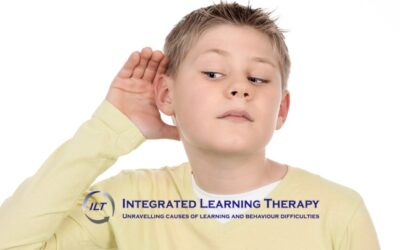
Left ear Right ear
Integrated Learning Therapy includes careful attention to aspects of a child’s auditory processing. We understand that children who have a left dominant ear, for example, may process spoken language more slowly. This means that a teacher’s instructions may not all be...