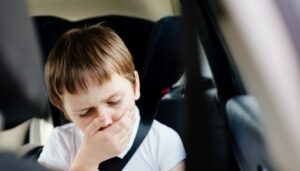
Why does my child get carsick?
Road trips are great ways to explore and teach children about their country. Booking family holidays in faraway places is exciting, especially for inland families who look forward all year to joining the exodus to the sea. But these trips become a nightmare if one of the family is prone to carsickness. In some cases, even a drive to the supermarket is something to avoid. Why do some children suffer from this unpleasant condition? Is it just a passing phase or could it be a sign of something else?
To answer these questions, we need to understand what causes the nausea that characterises carsickness and, of course, seasickness too. It’s all due to our senses and the fact that the human brain needs input from the sense organs to accurately perceive the world. Most of our ability to function in the world relies on being able to interpret the messages coming in from our senses. We are at a distinct disadvantage if our vision, hearing, sense of touch, smell and other sensory organs are faulty, or if our brains are not able to make sense of the messages reaching it from the sensory receptors.
There are, however, more than five senses. Our sense of balance and movement is vital to being able to operate efficiently in the world. The receptor for these senses is located in the inner ear and known as the vestibular system.
We don’t use different senses in isolation. Being able to make accurate perceptions about everything in the world needs cooperation among the senses. For example, although the vestibular system is able to tell the brain that the head (and of course, the body with it) is moving forward, it uses vision or tactile (touch) information to help confirm how and where the head and body are moving.
This knowledge has led to a theory that has not yet been criticised. It concerns sensory conflict and explains motion sickness as a conflict between the sensory messages coming in from the visual and vestibular systems (and possibly other so called graviceptors of the abdomen) about movements of the head[1]. The symptom of nausea is produced by an incongruity between the messages relayed by the sensors of orientation (position) and those of movement. For example, the visual system of a child sitting in the back seat of a car or a sailor below the deck of a ship detects no movement. On the other hand, the vestibular system detects movement. So the brain isn’t able to confirm the acceleration and small shifts in movement detected by the vestibular system and those indicated by vision. This results in what is caused a lack of coherence between sensory information.
Following conflict in sensory information, central nervous system activity produces successive stages of motion sickness, from drowsiness to nausea.
In the case of children under the age of 8-10 years, the nausea may be as a result of the vestibular system being still underdeveloped. Although this system is one of the earliest to develop in humans, it continues to develop through early childhood. For this reason, we don’t need to be too concerned about the possible implications of motion sickness in young children.
If motion sickness continues past early childhood it may signify irregular functioning of the vestibular system (providing there are no visual problems, of course). This is why carsickness is fairly common in children with learning problems. The vestibular system is very often implicated in failure to thrive at school. If vestibular weakness is suspected, there are ways of restoring and improving function.
In the meantime, what to do about the travel sickness? Vestibular-enhancing medications are available, which are effective in combatting the symptoms. We also know that reading in a car or on winding roads or when the driver brakes suddenly is not advisable. Rather have the child focus on the distant landscape so the visual system has the same reference as the vestibular system. This is why sitting in the front seat is often helpful. When on a boat, make sure the child stays above deck, looking at the horizon. This will ensure that the visual system sees the movement of the horizon which will create the exact same reference as the vestibular system. Even better, when standing on the deck, make active movements to remain stable, because these motor commands will add their messages to the other sensory information. When riding in a car, making small movements to coincide with the movement of the car around corners, passing other cars, and so on, will also be helpful.
Hopefully, your child will outgrow car sickness but if not, do consider whether the functioning of his or her balance system might be contributing to the problem. History tells us that Admiral Nelson was seasick when at sea for his entire life. I can’t help but wonder about his vestibular system!
Integrated Learning Therapy (ILT) understands the significance of vestibular functioning for successful learning. If you would like to know more about this approach, visit our website at www.ilt.co.za. We have practitioners listed around this country and others who are able to help you and we offer training to parents, teachers and other professionals to learn more about aspects of our approach.
If you would like to receive more articles like this, remember to Share and Like our Facebook page.
[1] Alain Berthoz. 2000. The brain’s sense of movement. Harvard Press.