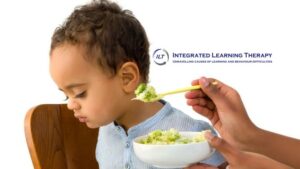
The number of children who are described as ‘picky eaters’ seems to be huge. So many desperate parents dread mealtimes which become battle fields, with children resorting to tears, spitting out food, vomiting, throwing food on the floor and so on.  Parents fluctuate between clownish behaviours (‘Look, here comes a chook-chook into the tunnel …’), angry orders (‘If you don’t eat you can’t have a story’) and their own emotional tears of despair.

Why is feeding children such a problem? Often children start out by taking their solids happily but typically begin to refuse food around the age of one year.  The trouble starts with visits to the clinic or paediatrician and the child’s weight, head diameter and other measures are seen not to match the charts used to gauge ‘normal’ growth.

So is the problem our expectations created by perceptions of normality or the child’s seeming urge to starve themselves and suffer poor health throughout life?

It might well be our perceptions that need adjusting if you believe Dr Carlos Gonzalez.  His book isn’t new but it certainly carries a comforting message to families who are concerned about a reluctant young eater.

To start with, Dr Gonzalez remind us that children typically show a slowed growth rate at around one year and may remain small eaters until puberty – when they change and suddenly turn into ravenous fridge raiders.

He also challenges the emphasis placed on growth charts.  The percentile curves are drawn up according to statistics and don’t necessarily ‘fit’ the weight or height gain of an individual child.  Instead of fretting about each meal, allow your child to dictate what and how much she will eat.  If, after a couple of days, her weight has not dropped by 1 kg, you’ll know there is nothing to worry about.

Basically, the message is that babies don’t eat because they don’t need to or they are full. Certainly he advocates breastfeeding until the age of 2 years and if children are receiving breast milk, they don’t actually need much in the way of solids.  He believes that breastfeeding should be on demand and reminds us that breastfed babies will not accept solids as willingly as those who are bottle fed.

Babies tell you they are not hungry by non-verbal communication. Typically they will:

  • Turn their heads away and close their mouths
  • Accepting the food, chewing it a little bit and then spitting it out
  • Vomiting it up

Solids introduced at six months is advocated, but rather than present a dishful of food, offer a variety of foods at each meal. Don’t worry if they peck at one or more foods like a bird, they will be gradually becoming accustomed to the texture, smell and taste of the foods and benefit from taking in a few calories.

In brief, he lists some rules for food (p.112) as follows:

  1. Never force a child to eat
  2. Breastfeed exclusively for 6 months and then continue for 2 years and beyond
  3. Offer solids at six months, after breastfeeding. Bottle-fed babies should be having 500ml of formula a day
  4. Start with very small amounts of food (the tip of a teaspoon), without too many new foods at a time
  5. Limit foods containing gluten (i.e. give very small amounts)
  6. Drain cooked food
  7. Don’t add salt or sugar to foods
  8. Don’t be in a hurry to introduce allergenic foods, such as dairy, eggs, fish, soy, etc.

The book might be a refreshing and comforting approach to a problem that is enormous in many of our young families. Older parents often take a more relaxed approach to ‘picky’ and reluctant eaters. In fact, I’ve heard many interesting stories about such children. One concerns a young boy with a very restricted diet of virtually nothing but pasta and chips who developed into a keen and accomplished young cook after puberty, producing gourmet meals complete with a variety of vegetables!

The book might serve to encourage moms to feel better about the feeding situation. I’ve inserted the cover of the book, which is available from amazon books and kindle

Martin Doherty, writing for The Conversation, says that at the age of about four, children reach important milestones in brain development.

One of these is a huge improvement in understanding others’ thoughts and feelings. This is the start of empathy.  Another is in spatial thinking—understanding how objects are positioned and related. This is the beginning of the ability to read maps.

Martin and his colleague, Catherine Sayer, conducted a study with 175 two to five-year-olds to explore how children are able to use scale models to figure out where something is in the real world. At about four, children are able to use a scale model of a room to work out where something is. We thought that this might result from children’s understanding of how one thing can represent something else. But we actually found that four-year-olds’ ability to use scale models came from their spatial abilities.

At the same age, children start to understand that someone’s behaviour is due to what that person believes, not necessarily what is really the case. This has interesting consequences.

If you’ve played hide-and-seek with young children, you may have noticed that they aren’t always very good at it. They love the ritual of looking in all the wrong places first, but beforehand they may tell you where they are going to hide, hide in the same place every time, or not be especially hidden.

After their fourth birthday, they get much better at hide and seek. They understand that the seeker looks in the wrong places because they don’t know where the hider is.

At about three to four children also start to tell lies. They realize they can make someone believe something that isn’t true.

Understanding symbols

Martin’s earlier research with fellow psychologist Josef Perner suggests that four-year-olds don’t just start to understand how others’ minds work. Figuring this out is part of the development of an understanding of “representation”—that symbols, like thoughts, words, or pictures, can be used to stand for something else.

Children start to think about how words relate to objects. This means, for instance, knowing that “animal” can refer to something you already have a name for, such as “rabbit”. This might help children learn the new word.

Their ability to use a understand the components of pictures also improves around this age. Very young children use a lot of trial and error to complete a jigsaw, picking up random pieces to see if they fit. By the time they are about four years old, they start to use the picture as a guide, trying to connect lines and match bits of colour, while checking the guide picture on the box lid.

Developmental experiments

Another ability children develop at around four is using scale models. A classic set of developmental experiments involved a model of a regular household room. The real room had typical furniture—sofa, table, cupboard and so on—and the model had miniature versions laid out in the same way.

Children were shown where something was hidden in the model and told to find an object hidden in “the same place” in the room. Children of around four can find the object using the identical layouts. If shown a sticker under a particular chair in the model room, for example, they can go straight to the “same” chair in the other room. This is the fundamental understanding required to read maps.

Adults see scale models and maps as representations. Maps represent a town or a country. A scale model of, say, the Eiffel Tower represents the real thing. At first, Martin suspected children’s ability to use scale models is more evidence of understanding representation at this age.

He was wrong. Instead, the researchers found that this ability is based on a development in children’s spatial abilities that also occurs at about four. This is the ability to think about spaces and where objects are within them. Spatial abilities help with maths skills, and good spatial ability is linked to an interest in science, technology, engineering and mathematics.

Their experiment was simple. They compared the model room task with a test of understanding how representation works. The two abilities develop around the same age, but they found they were not related. Children who could do one task couldn’t necessarily do the other.

They also had a test of purely spatial ability. Children who passed the model room task also passed the spatial task. So it looks like the model room task relied on children‘s spatial thinking.

They don’t yet know why two important but apparently unrelated abilities arise at the same time. Perhaps it’s related to changes in the growing brain at this  interesting age.

Provided by The Conversation

Image supplied by Freepik.