
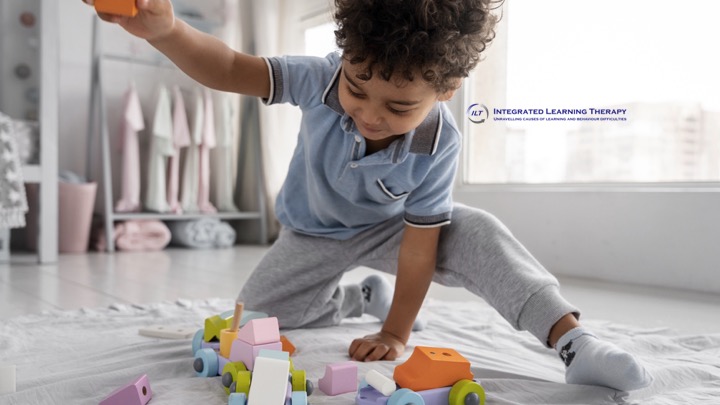
Four-year olds shouldn’t be sitting still

Four-year olds shouldn’t be sitting still

Children aged four and five and attending pre-school should not be sitting still at tables for any length of time.  Lucy Sors and Louise Whitfield, experts in  primary education, express their belief that expecting children to sit and formally learn how to write at this early stage conflicts with widely accepted theories around cognitive and physical development.

Research emphasises the importance of active play and exploration, leading to children understanding their world and supporting their language, communication and thought. In addition, physical play develops strength, coordination and motor skills which are necessary before being given a pencil to write. They should be encouraged to move and explore through free play instead of sitting still.

Through role playing, they learn how to communicate, question and hold conversations before following instructions.

At these young ages, children’s enjoyment of learning should be the priority.  For every child this will, of course, be different and education practices should respond to children’s preferences and interests.  Countries following the belief in the power of play in childhood include Finland, where children start primary school at the age of seven years.  In New Zealand, early childhood education follows a “play-based” curriculum which promotes the power of storytelling and play to build foundations in reading, writing and maths.

Sors and Whitfield emphasise that when we play, listen, read and talk with children, we give them a great start in life. This begins with looking at them as individuals. Learning in the early years should foster a love of learning, promote positive relationships and help children to understand the world.  Nurture, care, play and exploration should be prioritized to develop confident, resilient, and adaptable learners who can navigate a fast-changing world.

Supplied by The Conversation

Image supplied by Freepik

The power of play in childhood

The power of play in childhood

We are very aware of how children love to play.  Indeed, they need to play.  Not only because it gives them pleasure but also because it is a vitally important part of their learning.

Texas A&M University published an article stressing the power of play. In it, they write that play is how young children make sense of the world.  Through their toys, they use play to explore, experiment, and learn. Research recommends that, in early childhood, children have at least an hour of open-ended play each day.

During this time, they should be encouraged to ask questions, test ideas and engage in creative thinking. Play is not just fun but forms a foundation for their development and learning. Play supports cognitive growth, language and communication skills, social and emotional development, physical coordination, creativity, and overall school readiness.

The writers offer some tips as to how parents can support their child’s development as they play.  Here are three strategies.

Let your child lead

Notice what your child is already doing during play. You don’t need to give instructions or take control — just follow their lead and support their curiosity. Join in by asking open-ended questions that encourage deeper thinking. For example, if your child is building a tower, you might say, “Oh no, it keeps falling! What can you do to make it stronger?” Being nearby and engaged shows your child that their ideas matter and helps them build problem-solving skills through play.

Provide a variety of materials

Instead of offering just one type of toy, try giving your child multiple kinds of play materials at once. For example, provide blocks as well as cars, dolls, and figurines too! Your child might build a house for the dolls or create an entire town with roads, buildings, and characters. Mixing materials encourages creativity, problem-solving, and storytelling, opening the door to endless imaginative possibilities.

Narrate and label

As your child plays, talk about what they’re doing in the moment. This might sound like narrating emotions— “I can see you’re feeling a big emotion right now. You seem excited to start building with the blocks?”—or labelling their actions— “Wow, you are building a tall tower! You were so creative in the way you built your tower with more blocks on the first row and just one block on the last row!” By narrating and labelling during play, you help your child develop language to describe their behaviours, build new vocabulary, reinforce concepts like colours, shapes, and actions, and support their emotional awareness. Most importantly, describing children’s behaviour shows your child that you’re tuned in and encourages them to keep exploring and expressing themselves.


Article provided by Texas A&M University

Image provided by Freepik