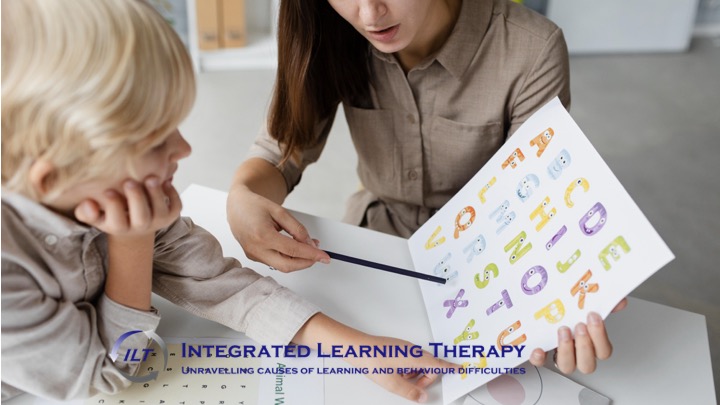
What causes a reading problem?

What causes a reading problem?

Why are there so many bright and hard-working children in our schools that aren’t learning to read as they should?  Interestingly, if you read something to them, giving them information through their ears, they understand.  But when you give them the same words to read or to absorb through their eyes, they fail.  Reading problems seem different from hearing or understanding problems, yet it is the same brain showing these differences in ability.

Our brains are ultimately responsible for us being able to read.  If a child struggles to make sense of written words, surely it must be related to problems in some or other area of the brain.  Is this true and if so, which brain areas are not functioning as they should?[1]

 Essentially, reading needs a brain

  • That can change light waves into electro-chemical impulses through the visual system
  • That has organized, adequately insulted neural networks through which the electro-chemical impulses can travel efficiently
  • With an area where storage, retrieval and decoding of information can take place efficiently.

 Which of these might help us understand why reading problems occur?

 If a child can look at a cow and recognise it as a cow, he perceives it. This means that he interprets the image correctly as being a cow.  The light waves from the cow are changed to electro-chemical impulses by the retina in the eye, then pass on to the brain.  If there is no conflicting information coming in from the cow, the child will perceive a cow. Children with reading problems have no problem recognising objects.  In essence, they can read all the physical things in their environment; they have no trouble recognising and perceiving actual objects.

 If we show him a picture of those objects he recognise the pictures quite easily.  He can, in essence, ‘read’ the pictures.  Pictures aren’t real objects but are symbols which stand for the objects but they are closely related to the objects. The picture of a cow is easily related to a cow because the picture (the symbol) represents what an actual cow looks like.

 If a child with a reading problem easily recognises a cow when he sees one, and he easily recognises a picture of a cow, why can’t he recognise the written word ‘cow’?  What is there about written words which make them different from the real thing or from pictures?  The problem seems to be one of language.

 Language is a man-made code, composed of symbols that have no meaning in themselves.  The word ‘cow’ is a symbol with no relation to the way an actual cow appears to the eye or brain.

To be able to use the code, we first have to memorise the meaning assigned to each symbol. If either the memory of the symbol or the memory of its assigned meaning is forgotten, the code breaks down. Thus, storage of both the symbol and its meaning is essential to memory. We know that language is stored in the left brain hemisphere. This means that language and decoding functions needs organized ‘wiring’ or neural pathways that convey information to this area.  Any scrambling of the network due to shorted wires, inadequate connections cause a breakdown in transmitting the electrical messages.

Once the symbol and its meaning have been stored, we have to be able to retrieve it.  Decoding needs a storehouse from which information is easily retrieved. Poor storage in the brain slows down the process of retrieval of information; children who suffer from this slow-down might speak more slowly, or read more slowly.  If incoming information is stored in an excessively disordered way, then we have a reading problem.

 Following this analysis, it seems that reading problems can be the result of lack of development of the nervous system, especially if underdevelopment results in undecided or cross-dominance.

 Confirmation of this theory comes by looking at other, sometimes subtle, signs of brain underdevelopment that children with reading problems commonly share.  Some of these include

  • Problems with coordination. They seem to lack grace when walking and running, often have a history of skipping crawling or cannot crawl smoothly without concentrating on doing so
  • Early problems with deciding hand, foot and eye dominance, and showing uncertain dominance after the age of 6 years
  • Show an extreme love for music and listening to music
  • Handwriting characteristically shows little consistency of slant; vertical lines of letters such as ‘h,j,p,t,l” make all kinds of different angles
  • Eye problems even though eyes test as normal.  Many have problems with binocular vision or eye tracking movements
  • Many reverse words or letters
  • Most are poor spellers
  • Many seem to do better in numeracy than reading and all prefer verbal discussions to having to write something down
  • Nearly all poor readers understand language better through their ears than through their eyes.

 So reading problems are related to the development of the nervous system.  No amount of remedial reading will be as effective as addressing the nervous system inefficiencies directly.

 This is one reason why Integrated Learning Therapy evaluates the neurodevelopmental status of children with reading problems.  We don’t address the symptoms of the problem, but go to the root cause.  Once we understand the underlying causes, we are able to design an individualized programme for the child to give the brain a second chance to develop properly.  By understanding the brain’s plasticity and thus its ability to restructure neural networks, we can stimulate brain areas.  This results in more organized neural networks and better access to storage areas of the language brain.

[1] With thanks to Carl Delacato and insights from his book A new start for the child with reading problems.

Image supplied by Freepik

Printed books still best for learning to read

Printed books still best for learning to read

Madeline Strauss, of Michigan State University reports on a study into the comparative value of digital methods versus ‘old fashioned’ simple ways of learning to read among pre-schoolers.  It seems that writing letters and spotting words in print in everyday life in a home environment is more effective.

The home literacy environment represents an important but small period when children in preschool learn literacy skills outside the classroom. It often represents activities such as writing names, pointing out print on signs, practicing letter sounds, shared book reading, discussing stories and literacy games such as flashcards or alphabet videos.

In contrast, a digital literacy programme involves children spending time with digital reading games on Apps or other form of technology.

The study involved more than 1,000 children between the ages of 3 and 6, with over 200 of these having speech and/or language impairments.

There were several key findings. Print-focused activities consistently predicted stronger early literacy skills in all children studied. Children who spent more time on literacy games scored lower on reading assessments across both groups. So heavier use of games was associated with worse literacy outcomes, regardless of a child’s developmental background.

For the variable of shared book reading, it was only a significant predictor for children without speech and/or language impairments. So while the structure of the home literacy environment is similar for all children, there should be special attention when it comes to shared reading for those with disabilities.

The research challenges the assumption that more exposure to learning tools automatically means better results. Instead, it highlights the need for intentional, hands-on approaches. This doesn’t mean digital learning tools should be avoided; rather, they should be used more for supplemental learning rather than as a primary tool.

Bottom of Form

What parents should know about games

There are a few possible reasons why some games may not be helping. For example, certain games prioritize entertainment over education, employing flashy visuals and sounds that distract from the development of key skills.

For other games, even if high-quality, they lack personal, hands-on instruction, such as practicing writing or identifying real-world print—skills that are especially critical for children with speech and/or language challenges.

Teaching children early reading skills does not require expensive tools or programs. Everyday interactions with print learning opportunities are the most important. There are specific tips and actions that parents can take to encourage learning:

  • Spot letters together by finding letters on street signs, food packaging or menus.
  • Encourage writing and have your child write their name, draw letters or label pictures.
  • Make reading interactive by pointing to words, talking about letter sounds and asking questions while reading books.
  • Parents should be mindful of introducing games when children might be struggling. Thoughtfully integrate digital learning tools for supplemental learning.
  • Print-focused routines are especially important for children with learning impairments.

The study, published in the Journal of Research in Reading, was led by professors Lori Skibbe and Ryan Bowles in the Department of Human Development and Family Studies at the College of Social Science, as well as Nick Waters, a former postdoctoral researcher.


Provided by the University of Michigan

Image provided by Freepik


Why do some children struggle to read?

Why do some children struggle to read?

Why are there so many bright and hard-working children in our schools that aren’t learning to read as they should?  Interestingly, if you read something to them, giving them information through their ears, they understand.  But when you give them the same words to read or to absorb through their eyes, they fail.  Reading problems seem different from hearing or understanding problems, yet it is the same brain showing these differences in ability. 

Our brains are ultimately responsible for us being able to read.  If a child struggles to make sense of written words, surely it must be related to problems in some or other area of the brain.  Is this true and if so, which brain areas are not functioning as they should?[1] 

Essentially, reading needs a brain

  • That can change light waves into electro-chemical impulses through the visual system
  • That has organized, adequately insulted neural networks through which the electro-chemical impulses can travel efficiently
  • With an area where storage, retrieval and decoding of information can take place efficiently.

Which of these might help us understand why reading problems occur? 

If a child can look at a cow and recognise it as a cow, he perceives it. This means that he interprets the image correctly as being a cow.  The light waves from the cow are changed to electro-chemical impulses by the retina in the eye, then pass on to the brain.  If there is no conflicting information coming in from the cow, the child will perceive a cow. Children with reading problems have no problem recognising objects.  In essence, they can read all the physical things in their environment; they have no trouble recognising and perceiving actual objects.

If we show him a picture of those objects he recognise the pictures quite easily.  He can, in essence, ‘read’ the pictures.  Pictures aren’t real objects but are symbols which stand for the objects but they are closely related to the objects. The picture of a cow is easily related to a cow because the picture (the symbol) represents what an actual cow looks like.

If a child with a reading problem easily recognises a cow when he sees one, and he easily recognises a picture of a cow, why can’t he recognise the written word ‘cow’?  What is there about written words which make them different from the real thing or from pictures?  The problem seems to be one of language.

Language is a man-made code, composed of symbols that have no meaning in themselves.  The word ‘cow’ is a symbol with no relation to the way an actual cow appears to the eye or brain.

To be able to use the code, we first have to memorise the meaning assigned to each symbol. If either the memory of the symbol or the memory of its assigned meaning is forgotten, the code breaks down. Thus, storage of both the symbol and its meaning is essential to memory. We know that language is stored in the left brain hemisphere. This means that language and decoding functions needs organized ‘wiring’ or neural pathways that convey information to this area.  Any scrambling of the network due to shorted wires, inadequate connections cause a breakdown in transmitting the electrical messages. 

Once the symbol and its meaning have been stored, we have to be able to retrieve it.  Decoding needs a storehouse from which information is easily retrieved. Poor storage in the brain slows down the process of retrieval of information; children who suffer from this slow-down might speak more slowly, or read more slowly.  If incoming information is stored in an excessively disordered way, then we have a reading problem.

Following this analysis, it seems that reading problems can be the result of lack of development of the nervous system, especially if underdevelopment results in undecided or cross-dominance. 

Confirmation of this theory comes by looking at other, sometimes subtle, signs of brain underdevelopment that children with reading problems commonly share.  Some of these include

  • Problems with coordination. They seem to lack grace when walking and running, often have a history of skipping crawling or cannot crawl smoothly without concentrating on doing so
  • Early problems with deciding hand, foot and eye dominance, and showing uncertain dominance after the age of 6 years
  • Show an extreme love for music and listening to music
  • Handwriting characteristically shows little consistency of slant; vertical lines of letters such as ‘h,j,p,t,l” make all kinds of different angles
  • Eye problems even though eyes test as normal.  Many have problems with binocular vision or eye tracking movements
  • Many reverse words or letters
  • Most are poor spellers
  • Many seem to do better in numeracy than reading and all prefer verbal discussions to having to write something down
  • Nearly all poor readers understand language better through their ears than through their eyes.

So reading problems are related to the development of the nervous system.  No amount of remedial reading will be as effective as addressing the nervous system inefficiencies directly.

[1] With thanks to Carl Delacato and insights from his book A new start for the child with reading problems.

Image supplied by Freepik

Reading difficulties – A symptom not the cause of problems

Reading difficulties – A symptom not the cause of problems


(With thanks to Svea Gold)

When Mat fails to learn to read at grade level, his parents are encouraged to help him with extra reading at home, or refer him for remedial reading.  This often doesn’t help very much and the reason is that reading failure is a symptom that the child has an underlying problem.   His problem may not be the act of learning to read at all.  The struggle to read is a red flag signifying that there is something going on in Mat’s brain that is the real reason for his problem. 

For example, if the two sides of Mat’s brain aren’t communicating properly, the eyes won’t function properly either.  Most people see words with each eye.  If you are reading the words THE CAT your right and left eyes will separately see the words (THE CAT and THE CAT), then send the signals to the brain.  The brain, in turn, superimposes the two images into one and you ‘read’ the words: THE CAT.

If Mat’s eyes are not functioning properly, he might look at the two images and see: THE TCAT CAT.  He can’t make sense of this so can’t read it.  He blinks and looks again.  This time he sees: THE CATHE CAT.   Mat decides that he really sucks at reading and must be very stupid!

It isn’t simply a question of seeing.  An optometrist finds that Mat has perfectly normal vision.  The truth is that efficient reading depends on many skills, not only the health and visual acuity of the eyes.  The problem may be more deep seated – caused by faulty wiring in the brain, that we call ‘neurological disorganization’ or ‘incomplete neurological organisation’.   If the child’s inability to read is the result of incomplete neurological organization, there will be other significant clues.  If his eyes don’t function well together, he will most likely get tired quickly; he may find that certain sports are difficult; most likely his coordination will be poor and he may show awkward movements. 

Many children with learning problems show a lack of coordination stemming from poor neurological organization.  These children are not stupid but merely need help in rewiring the brain networks to bring about organized neural pathways needed for reading, writing and numeracy.  ILT practitioners see this day after day.  Once the correct connections have been made in Mat’s brain, he might suddenly take off and develop rapidly in many areas.

Clues to neurological disorganistion

Here are some of the signs of a disorganized brain that many children with reading problems (also labelled as dyslexia) show:

  • They lack coordination. Running, walking even crawling seem awkward and lack grace and smoothness
  • They have undecided or delayed dominance, meaning that they show uncertain preference for writing, for throwing, stepping on a stool, etc. This lack of a clear dominant side exists way beyond the age of six years, when most children have developed clear dominance.
  • They seem to love music
  • Their handwriting has no consistent slant: their letters seem to have different angles and go in different directions
  • They show signs of visual difficulties – often holding their noses close to the paper when reading or writing
  • Many reverse letters and numbers, mixing up the directions of letters such as ‘b’ and ‘d’.  They may read ‘saw’ for ‘was’ or write numbers backwards
  • Most are poor spellers who may be drilled for a test but forget what they learn in a very short time
  • Many seem to manage maths better than reading and speak more fluently than they can express themselves in writing
  • Most seem to understand spoken language but struggle with written language.

The importance of neurodevelopment

Very often the brain does not develop normally if a stage of development is missed.  The eyes, for instance, learn to work together in the period when the child is crawling on hands and knees.  When the leading hand feels the floor, the eyes will reflexively focus on that hand.  This helps both eyes focus on one point at the same time.  The two images from the two eyes are superimposed in the brain and the child sees one image and not two.  Crawling is also very important in helping the child judge distance, an ability needed when writing.

During this all-important crawling stage, the ears are also learning to work together.  As the forward hand hits the floor, the head moves gently from side to side as the eyes follow the hand.  This provides stimulation to the vestibular system in the inner ears, and much of the information leading to the speech centre is coordinated through this system.  The vestibular system coordinates visual perception with the ability of judging where the sound comes from and helps the brain make the postural adjustments to allow the child to move freely.

This is just one example to emphasise the importance of the crawling stage in infancy.  Parents need to severely limit the time that babies are kept in playpens, walking rings, car seats and such like.  These prevent the infant from learning the normal crawling patterns which are so vital for coordinating all the functions of the body.  

How do we address this?

ILT practitioners look for clues that point to inadequate functioning or underdevelopment of brain areas that support learning in their young clients.   They also appreciate the role of nutrition in brain functioning and know that a healthy brain depends on the body being healthy and well nourished.   

Once the underlying causes of the child’s problem have been uncovered, a programme of individualized activities are given to the family to be done at home every day.  The child’s progress is monitored through a series of programme reviews, in order to adjust the activities according to progress shown.   

This process basically gives the brain a second chance to develop all areas and so make it possible for the child to ‘catch up’ on those difficult academic areas.


The benefits of shared reading

The benefits of shared reading

The American Academy of Pediatrics encourages parents and caregivers to read aloud with their newborns and young children.  In a recent policy statement, they say that this is an opportunity to foster loving, nurturing relationships during a critical time of brain development.

The policy statement is “Literacy Promotion: An Essential Component of Primary Care Pediatric Practice.”  There has been an extraordinary amount of research in this area, and an accompanying new technical report reviews the evidence for shared reading as a way to strengthen and nurture relationships, stimulate brain circuitry and create early attachments.

“Reading together with young children weaves joyful language and rich interactive moments into the fabric of daily life,” said Perri Klass, MD, FAAP, lead author of both statements.

“As a pediatrician and parent, I suggest making books your bedtime routine, using them to connect and wind down after a busy day, and generally building them into life with a young child. It will strengthen the bonds that hold you together, and build your child’s developing brain.”

Policy statements and technical reports created by AAP are written by medical experts, reflect the latest evidence in the field, and go through several rounds of peer review before being approved by the AAP Board of Directors and published in Pediatrics.

The AAP emphasizes that, as a positive parenting practice, shared reading helps build the foundation for healthy social-emotional, cognitive, language, and literacy development. This sets the stage for school readiness and provides enduring benefits across the life course.

“Turning the pages of a high-quality, print book filled with colourful pictures and rich, expressive language are best,” said Dipesh Navsaria, MD, MPH, MSLIS, FAAP, a co-author of the technical report and chair of the Council on Early Childhood.

“While touchscreens and other electronic devices may be popular, they are typically passive or solitary experiences for children and do not offer the same benefits of interactivity and relationship-building.”

“Research tells us that reading proficiency by third grade is a significant predictor of high school graduation and career success,” Dr. Klass said.

“Children who first encounter books in the arms of their parents, when they are very young, arrive at school associating books and reading with lap-time, a sense of security, interactions, stories, rhymes and entertainment, and above all with the beloved voices of the adults with whom they have those all-important early relationships.”


Image supplied by Freepik.


More information: Claudia Aristy and Dr. Klass discuss the policy during a plenary session, “Turning Pages Together: How Pediatricians Rewrote the Book on Early Literacy,” from 10:30-noon ET Sunday in the Orange County Convention Center Valencia Ballroom.

Journal information: Pediatrics