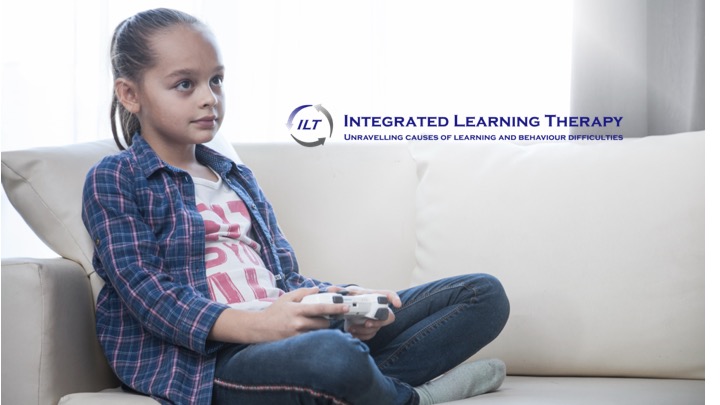
Are some children more vulnerable to video games?

Are some children more vulnerable to video games?

It seems that even small amounts of video games can trigger a response in certain children. Most at risk are particularly sensitive – being children in homes, in foster care and even adopted children.  Such children share a symptom due to trauma that results in changes in the brain and body – namely, a ‘hair trigger’ response to perceived stress that put their little bodies into a nearly constant state of fight or flight.  This state is characterised by emotional reactivity, trouble following directions, meltdowns over small frustrations and high arousal (getting ‘revved up’ easily).

The smallest amount of time spent playing video games may trigger the stress reaction – which makes sense if you consider that such children live very close to their stress threshold. It takes far less to push them into full-blown stress mode than more relaxed peers.

Another set of children found to be particularly sensitive are those with tics or Tourette’s syndrome.  In these children, overactive areas of the brain cause involuntary motor activity. The exacerbation of symptoms caused by video games in this group was even more obvious. With some of these children, gaming increased their overall tic frequency and severity, and with others, the tics would ratchet up whenever the child actually played the game or used the computer.  Again, removal of the video games often produces significant relief.

There may be something about playing video games that puts the brain and body into overdrive, which increases both neurological and psychological symptoms .  More recently those children with ADHD symptoms are thought to react in a similar way.

Even neurotypical  children could experience less extreme but nonetheless disruptive symptoms – which means that it isn’t just highly sensitive children or those with psychiatric disorders who are vulnerable to adverse effects, but potentially any child.

Image supplied by Freepik.


Some good news – Children’s brains might benefit from video games

Some good news – Children’s brains might benefit from video games

We have been led to believe that too much time spent on computers is harmful to children’s brain development.  This would include time spent playing video games.

 Video gaming has also been linked to depression and increased aggression.

A new study, published in JAMA Network Open recently, finds, however, that this pastime may in fact have cognitive benefits .

 For the new research, Bader Chaarani and colleagues analysed data from the large and ongoing Adolescent Brain Cognitive Development (ABCD) Study, which is funded by the National Institutes of Health in the USA.

They looked at survey answers, cognitive test results, and brain images from around 2,000 nine- and ten-year-olds, who were separated into two groups: those who never played games, and those who played for three hours or more a day.

This threshold was chosen as it exceeds the American Academy of Pediatrics screen time guidelines of one or two hours of video games for older children.

Impulses and memory

Each group was assessed in two tasks.

The first involved seeing arrows pointing left or right, with the children asked to press left or right as fast as they could. 

They were also told to not press anything if they saw a “stop” signal, to measure how well they could control their impulses. 

In the second task, they were shown people’s faces, and then asked if a subsequent picture shown later on matched or not, in a test of their working memory.

After using statistical methods to control for variables that could skew results, such as parental income, IQ, and mental health symptoms, the team found the video gamers performed consistently better on both tasks.

As they performed the tasks, the children’s brains were scanned using functional magnetic resonance imaging (fMRI). Video gamers’ brains showed more activity in regions associated with attention and memory.

“The results raise the intriguing possibility that video gaming may provide a cognitive training experience with measurable neurocognitive effects,” the authors concluded in their paper. 

Of course, it is not clear from this study whether better cognitive performance is the result of gaming or the reason why children enjoy gaming.  The team hope to get a more clear answer as the study continues and they look again at the same children at older ages.

This will also help exclude other potential factors at play such as the children’s home environment, exercise and sleep quality.

Future studies could also benefit from knowing what genres of games the children were playing—though at age 10 children tend to favor action games like Fortnite or Assassin’s Creed.

In spite of this intriguing result, Chaarani does warn that excessive use of screen time is bad for overall mental health and physical activity.  However, the study shows that video games might be a better use of screen time than watching videos or other mindless programmes, which has no discernible cognitive effects. 

Some good news: Children’s brains may benefit from video games

Some good news: Children’s brains may benefit from video games

We have been led to believe that too much time spent on computers is harmful to children’s brain development.

This would include time spent playing video games. Video gaming has also been linked to depression and increased aggression.

A new study, published in JAMA Network Open recently, finds, however, that this pastime may in fact have cognitive benefits .

For the new research, Bader Chaarani and colleagues analysed data from the large and ongoing Adolescent Brain Cognitive Development (ABCD) Study, which is funded by the National Institutes of Health in the USA.

They looked at survey answers, cognitive test results, and brain images from around 2,000 nine- and ten-year-olds, who were separated into two groups: those who never played games, and those who played for three hours or more a day. This threshold was chosen as it exceeds the American Academy of Pediatrics screen time guidelines of one or two hours of video games for older children.

Impulses and memory

Each group was assessed in two tasks. The first involved seeing arrows pointing left or right, with the children asked to press left or right as fast as they could.

They were also told to not press anything if they saw a “stop” signal, to measure how well they could control their impulses.
In the second task, they were shown people’s faces, and then asked if a subsequent picture shown later on matched or not, in a test of their working memory.

After using statistical methods to control for variables that could skew results, such as parental income, IQ, and mental health symptoms, the team found the video gamers performed consistently better on both tasks.

As they performed the tasks, the children’s brains were scanned using functional magnetic resonance imaging (fMRI). Video gamers’ brains showed more activity in regions associated with attention and memory.

“The results raise the intriguing possibility that video gaming may provide a cognitive training experience with measurable neurocognitive effects,” the authors concluded in their paper.

Of course, it is not clear from this study whether better cognitive performance is the result of gaming or the reason why children enjoy gaming. The team hope to get a more clear answer as the study continues and they look again at the same children at older ages. This will also help exclude other potential factors at play such as the children’s home environment, exercise and sleep quality.

Future studies could also benefit from knowing what genres of games the children were playing—though at age 10 children tend to favor action games like Fortnite or Assassin’s Creed.

In spite of this intriguing result, Chaarani does warn that excessive use of screen time is bad for overall mental health and physical activity.

However, the study shows that video games might be a better use of screen time than watching videos or other mindless programmes, which has no discernible cognitive effects.

Integrated Learning Therapy (ILT) strives to uncover the root causes of puzzling behaviours and learning difficulties in children. Click here to learn more about this approach.

We list practitioners near you to help as well as the accredited courses we offer parents, teachers and other helping professionals to become more knowledgeable about brain development and what might go wrong.

Teachers earn 15 TCPD points for successful completion of the course as well as credits from ETDP-SETA for further studies in Special Needs Education. Parents are also credited with ETDP-SETA and so ILT can be a pathway to further academic study.

ILT 1 courses are available as attendance or by correspondence.