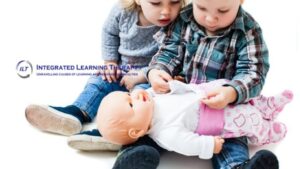
A study done by neuroscience researchers from Cardiff University explored the impact that playing with dolls has on children.  Over a period of 18 months they monitored the brain activity of 33 children, aged between four and eight, as they played with dolls.

The study, conducted with Mattel, the makers of Barbie, is the first time neuroimaging data has been used to highlight how the brain is activated during natural doll play. As such, the researchers say it is a step forward in developmental science’s understanding of this type of play.

In the study the play was split into different sections so the Cardiff team could capture the brain activity relating to each kind of play separately – playing with the dolls on their own; playing with the dolls together with another person (a research assistant); playing with the tablet game on their own and playing with the tablet game along with another person (a research assistant).

They found that doll play activated parts of the brain that allow children to develop empathy and social information processing skills, even when they were playing alone. Furthermore, they saw far less activation of this part of the brain when the children played with tablet computers on their own. The study included both genders and the results were the same for boys and girls.

The findings of the study have been published in the journal Frontiers in Human Neuroscience.

Lead author Dr Sarah Gerson, a senior lecturer at Cardiff University’s Centre for Human Developmental Science, said: “This is a completely new finding. (It) shows that playing with dolls is helping them rehearse some of the social skills they will need in later life. Because this brain region has been shown to play a similar role in supporting empathy and social processing across six continents, these findings are likely to be country agnostic.”

“We use this area of the brain when we think about other people, especially when we think about another person’s thoughts or feelings,” said Dr Gerson. “Dolls encourage them to create their own little imaginary worlds, as opposed to say, problem-solving or building games. They encourage children to think about other people and how they might interact with each other.”

They found that doll play activated parts of the brain that allow children to develop empathy and social information processing skills, even when they were playing alone. Image is credited to Cardiff University.

The dolls used included a diverse range of Barbies and sets. Tablet play was carried out using games that allow children to engage with open and creative play (rather than a rule or goal-based games) to provide a similar play experience to doll play.

The study found that when children played alone with dolls, they showed the same levels of activation of the pSTS as they do when playing with others. When the children were left to play tablet games on their own there was far less activation of the pSTS, even though the games involved a considerable creative element.

The researchers say the study is the first step towards understanding the impact of doll play and further work is required to build on these initial findings. Dr Gerson and the Cardiff University team, along with Mattel, have committed to further neuroscience studies in 2021.


Martin Doherty, writing for The Conversation, says that at the age of about four, children reach important milestones in brain development.

One of these is a huge improvement in understanding others’ thoughts and feelings. This is the start of empathy.  Another is in spatial thinking—understanding how objects are positioned and related. This is the beginning of the ability to read maps.

Martin and his colleague, Catherine Sayer, conducted a study with 175 two to five-year-olds to explore how children are able to use scale models to figure out where something is in the real world. At about four, children are able to use a scale model of a room to work out where something is. We thought that this might result from children’s understanding of how one thing can represent something else. But we actually found that four-year-olds’ ability to use scale models came from their spatial abilities.

At the same age, children start to understand that someone’s behaviour is due to what that person believes, not necessarily what is really the case. This has interesting consequences.

If you’ve played hide-and-seek with young children, you may have noticed that they aren’t always very good at it. They love the ritual of looking in all the wrong places first, but beforehand they may tell you where they are going to hide, hide in the same place every time, or not be especially hidden.

After their fourth birthday, they get much better at hide and seek. They understand that the seeker looks in the wrong places because they don’t know where the hider is.

At about three to four children also start to tell lies. They realize they can make someone believe something that isn’t true.

Understanding symbols

Martin’s earlier research with fellow psychologist Josef Perner suggests that four-year-olds don’t just start to understand how others’ minds work. Figuring this out is part of the development of an understanding of “representation”—that symbols, like thoughts, words, or pictures, can be used to stand for something else.

Children start to think about how words relate to objects. This means, for instance, knowing that “animal” can refer to something you already have a name for, such as “rabbit”. This might help children learn the new word.

Their ability to use a understand the components of pictures also improves around this age. Very young children use a lot of trial and error to complete a jigsaw, picking up random pieces to see if they fit. By the time they are about four years old, they start to use the picture as a guide, trying to connect lines and match bits of colour, while checking the guide picture on the box lid.

Developmental experiments

Another ability children develop at around four is using scale models. A classic set of developmental experiments involved a model of a regular household room. The real room had typical furniture—sofa, table, cupboard and so on—and the model had miniature versions laid out in the same way.

Children were shown where something was hidden in the model and told to find an object hidden in “the same place” in the room. Children of around four can find the object using the identical layouts. If shown a sticker under a particular chair in the model room, for example, they can go straight to the “same” chair in the other room. This is the fundamental understanding required to read maps.

Adults see scale models and maps as representations. Maps represent a town or a country. A scale model of, say, the Eiffel Tower represents the real thing. At first, Martin suspected children’s ability to use scale models is more evidence of understanding representation at this age.

He was wrong. Instead, the researchers found that this ability is based on a development in children’s spatial abilities that also occurs at about four. This is the ability to think about spaces and where objects are within them. Spatial abilities help with maths skills, and good spatial ability is linked to an interest in science, technology, engineering and mathematics.

Their experiment was simple. They compared the model room task with a test of understanding how representation works. The two abilities develop around the same age, but they found they were not related. Children who could do one task couldn’t necessarily do the other.

They also had a test of purely spatial ability. Children who passed the model room task also passed the spatial task. So it looks like the model room task relied on children‘s spatial thinking.

They don’t yet know why two important but apparently unrelated abilities arise at the same time. Perhaps it’s related to changes in the growing brain at this  interesting age.

Provided by The Conversation

Image supplied by Freepik.