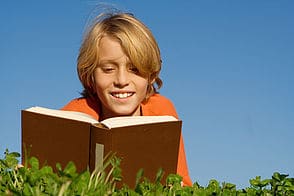
A study by Frontiers in Psychology

Are you under a deluge of constant ‘why?’ questions from your child or learner? It’s because children have an insatiable appetite to understand why things are the way they are. While researchers have been aware of children’s interest in information, they didn’t know whether it influenced children’s preferences during real-world activities, such as reading.

A new study in Frontiers in Psychology finds that children prefer storybooks containing more  information about why and how things work in the world. The results could help parents and teachers to choose the most engaging books to increase children’s interest in reading, which is important in improving early literacy and language skills.

Children have a burning urge to understand the mechanics of the world around them, and frequently bombard parents and teachers with questions about how and why things work the way they do (sometimes with embarrassing consequences). Researchers have been aware of children’s appetite for causal information for some time. However, no one had previously linked this phenomenon to real-world activities such as reading or learning.

“There has been a lot of research on children’s interest in causality, but these studies almost always take place in a research lab using highly contrived procedures and activities,” explains Margaret Shavlik of Vanderbilt University, Tennessee.

“We wanted to explore how this early interest in causal information might affect everyday activities with young children—such as joint book reading.”

Finding the factors that motivate children to read books is important. Encouraging young children to read more improves their early literacy and language skills and could get them off to a running start with their education. Reading books in the company of a parent or teacher is a great way for children to start reading, and simply choosing the types of book that children most prefer could be an effective way to keep them interested and motivated.

Shavlik and her colleagues hypothesized that children prefer books with more causal information. They set out to investigate whether this was true by conducting a study involving 48 children aged 3-4 years from Austin, Texas. Their study involved an adult volunteer who read two different but carefully matched storybooks to the children, and then asked them about their preferences afterwards.

“We read children two books: one rich with causal information, in this case, about why animals behave and look the way they do, and another one that was minimally causal, instead just describing animals’ features and behaviours,” said Shavlik.

The children appeared to be equally as interested and enthusiastic while reading either type of book. However, when asked which book they preferred they tended to choose the book loaded with causal information, suggesting that the children were influenced by this key difference. “We believe this result may be due to children’s natural desire to learn about how the world works,” explains Shavlik.

So, how could this help parents and teachers in their quest to get children reading? “If children do indeed prefer storybooks with causal explanations, adults might seek out more causally rich books to read with children—which might in turn increase the child’s motivation to read together, making it easier to foster early literacy,” said Shavlik.

The study gives the first indicator that causality could be a key to engaging young minds during routine learning activities. Future studies could investigate if causally-rich content can enhance specific learning outcomes, including literacy, language skills and beyond. After all, learning should be about understanding the world around us, not just memorizing information.

Martin Doherty, writing for The Conversation, says that at the age of about four, children reach important milestones in brain development.

One of these is a huge improvement in understanding others’ thoughts and feelings. This is the start of empathy.  Another is in spatial thinking—understanding how objects are positioned and related. This is the beginning of the ability to read maps.

Martin and his colleague, Catherine Sayer, conducted a study with 175 two to five-year-olds to explore how children are able to use scale models to figure out where something is in the real world. At about four, children are able to use a scale model of a room to work out where something is. We thought that this might result from children’s understanding of how one thing can represent something else. But we actually found that four-year-olds’ ability to use scale models came from their spatial abilities.

At the same age, children start to understand that someone’s behaviour is due to what that person believes, not necessarily what is really the case. This has interesting consequences.

If you’ve played hide-and-seek with young children, you may have noticed that they aren’t always very good at it. They love the ritual of looking in all the wrong places first, but beforehand they may tell you where they are going to hide, hide in the same place every time, or not be especially hidden.

After their fourth birthday, they get much better at hide and seek. They understand that the seeker looks in the wrong places because they don’t know where the hider is.

At about three to four children also start to tell lies. They realize they can make someone believe something that isn’t true.

Understanding symbols

Martin’s earlier research with fellow psychologist Josef Perner suggests that four-year-olds don’t just start to understand how others’ minds work. Figuring this out is part of the development of an understanding of “representation”—that symbols, like thoughts, words, or pictures, can be used to stand for something else.

Children start to think about how words relate to objects. This means, for instance, knowing that “animal” can refer to something you already have a name for, such as “rabbit”. This might help children learn the new word.

Their ability to use a understand the components of pictures also improves around this age. Very young children use a lot of trial and error to complete a jigsaw, picking up random pieces to see if they fit. By the time they are about four years old, they start to use the picture as a guide, trying to connect lines and match bits of colour, while checking the guide picture on the box lid.

Developmental experiments

Another ability children develop at around four is using scale models. A classic set of developmental experiments involved a model of a regular household room. The real room had typical furniture—sofa, table, cupboard and so on—and the model had miniature versions laid out in the same way.

Children were shown where something was hidden in the model and told to find an object hidden in “the same place” in the room. Children of around four can find the object using the identical layouts. If shown a sticker under a particular chair in the model room, for example, they can go straight to the “same” chair in the other room. This is the fundamental understanding required to read maps.

Adults see scale models and maps as representations. Maps represent a town or a country. A scale model of, say, the Eiffel Tower represents the real thing. At first, Martin suspected children’s ability to use scale models is more evidence of understanding representation at this age.

He was wrong. Instead, the researchers found that this ability is based on a development in children’s spatial abilities that also occurs at about four. This is the ability to think about spaces and where objects are within them. Spatial abilities help with maths skills, and good spatial ability is linked to an interest in science, technology, engineering and mathematics.

Their experiment was simple. They compared the model room task with a test of understanding how representation works. The two abilities develop around the same age, but they found they were not related. Children who could do one task couldn’t necessarily do the other.

They also had a test of purely spatial ability. Children who passed the model room task also passed the spatial task. So it looks like the model room task relied on children‘s spatial thinking.

They don’t yet know why two important but apparently unrelated abilities arise at the same time. Perhaps it’s related to changes in the growing brain at this  interesting age.

Provided by The Conversation

Image supplied by Freepik.